

自分とは違う文化や社会で育った人と深く友達になると、あるとき不思議な感覚になることがある。その人の属性が、透明になっていくのだ。
When you become deeply close friends with someone raised in a different culture or society, a strange feeling sometimes arrives: their attributes start to turn transparent.
もちろん、物事への反応や常識が違っていたり、逆に文化的に似ていたりと、そういう表面的な近さ・遠さはある。でも、属性の透明化はもっと抽象的なところで起きる。文化や背景が透明になって、その人の人格そのものに出会うような瞬間があるのだ。
Of course there's still surface-level closeness or distance — different reactions and common sense about things, or sometimes a surprising cultural overlap. But this transparency happens somewhere more abstract than that. Culture and background fade out of view, and there's a moment where you meet the person's character itself.
私は長い間、それをうまく説明できなかった。
For a long time, I couldn't explain that feeling.
その感覚に、なんとか説明をつけられないかと思った。もしかしたら、違いを差し引いたあとに残るものの中にこそ、人格そのものがあるのではないか——そう思ったのが、この話の出発点だ。
I wanted to find some way to explain that feeling. Maybe what's left after subtracting the differences is exactly where a person's character lives — that's where this train of thought started.
国籍を引いても残るもの What Remains After You Subtract Nationality
日本人の私と、まったく異なる文化圏で育った友人がいたとする。生の属性だけを見れば、私たちはかなり離れた存在だ。
Take me, someone raised in Japan, and a friend who grew up in a completely different culture. Looking only at our raw attributes, we're about as far apart as two people can be.
統計で考えると「残差」に近い In Statistical Terms, It's Close to a "Residual"
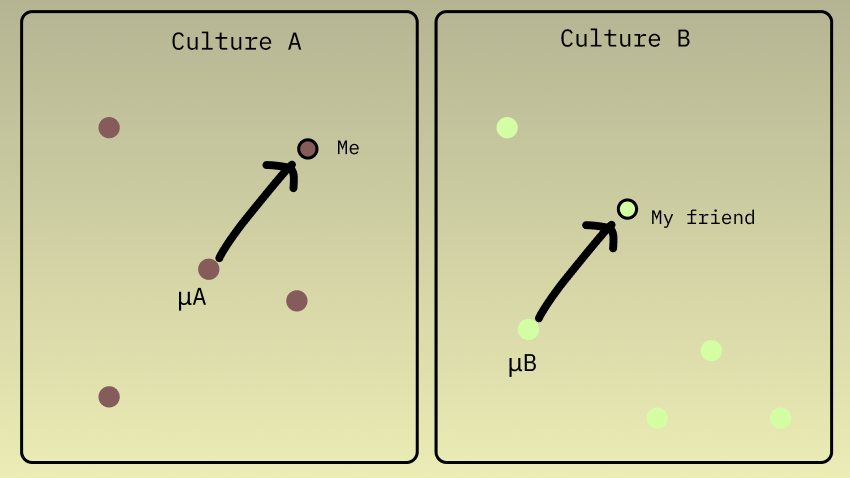
この感覚を無理やり数式にすると、統計の残差という考え方に近い。
If I force this feeling into an equation, it comes close to the statistical idea of a residual.
人をベクトルで表すと仮定すると、
Suppose you represent a person as a vector. Then you could decompose them as:
その人 = 文化圏の平均 + 個人固有のズレ
a person = the average of their cultural group + their individual deviation
と分解できる。文化圏の平均は、「その社会で典型的とされる傾向」。残差は、「その文化の平均からどの方向に、どれくらい外れているか」。
The group average is "the tendency considered typical in that society." The residual is "how far, and in which direction, a person strays from that average."
もし私たちが本当に惹かれているのが残差の向きだとすると、面白いことが起こる。生の属性では遠く離れた二人でも、それぞれの文化から同じ方向にずれているなら、残差ベクトルはよく似る。
If what we're actually drawn to is the direction of that residual, something interesting follows. Two people who are far apart in raw attributes can still have very similar residual vectors, as long as each has drifted from their own culture's average in the same direction.
つまり、
In other words, the phenomenon of
「育ってきた環境も違うのに気が合う」
"we grew up in completely different environments, and yet we click"
という現象は、
can be reread as
「異なる平均を持つ集団から、似た方向に外れた二人が出会った」
"two people, drifting from different averages, who happened to drift the same way."
と読み替えられる。
この見方には、傍証もある。異文化心理学では、価値観や性格特性の分散を分解すると、文化間の分散より文化内の分散のほうがずっと大きいことが知られている。つまり、文化圏の平均が説明できる部分は意外に小さく、個人を特徴づける情報の大半は、まさにこの残差に宿っている。
There's some supporting evidence for this view. In cross-cultural psychology, when you decompose the variance in values or personality traits, the variance within a culture tends to dwarf the variance between cultures. In other words, the group average explains surprisingly little — most of what characterizes a person lives exactly in this residual.
もちろん、このモデルには穴がある Of Course, There Are Holes in This Model
ただし、この話を「人間関係の真理」と言うつもりはない。少なくとも、次のような問題がある。
That said, I'm not claiming this is some truth about human relationships. At minimum, there are problems like these:
- そもそも「文化の平均」を正確に定義できない"the cultural average" can't actually be precisely defined in the first place
- 私たちが引いているのは統計的平均ではなく、しばしば自分のステレオタイプであるwhat we're subtracting in our heads is usually our own stereotype, not a statistical average
- 人は相手の全てを見ているわけではなく、自分が重視する少数の次元だけを見ているwe never see the whole of another person — only the handful of dimensions we personally care about
- 国際的な出会い自体が、もともと開放性の高い人同士に偏っている可能性があるinternational friendships themselves are likely skewed toward people who are already unusually open to begin with
つまり、「差し引いて残ったもの」が本当に客観的な個性なのかは、実はかなり怪しい。
Which means whether "what's left after subtracting" is really an objective trait is, honestly, pretty questionable.
「全然違くて、よく似ている。それが友達さ」 "Nothing alike — and yet so alike. That's what a friend is."
結局のところ、私たちが頭の中で行っている「引き算」は、厳密な統計処理ではない。それでも、何を平均とみなし、どの違いを無視するかを選ぶたびに、国籍や文化といった属性は少しずつ背景へと退き、代わりにその人固有の人格が、輪郭を持って立ち上がってくる。
In the end, the "subtraction" we're doing in our heads isn't rigorous statistics. And yet, every time we choose what counts as the average and which differences to set aside, attributes like nationality and culture recede a little further into the background — and in their place, a person's own character rises into relief.
だからこのモデルは、相手の客観的本質を発見したというより、自分と相手が共同で作り上げた一つの解釈なのだと思う。それでも私は、この解釈に価値を感じている。
So this model, I think, isn't really discovering some objective essence in the other person — it's an interpretation the two of us build together. And still, I find real value in that interpretation.
人と出会うたびに、「この人はどこの国の人か」よりも、
Every time I meet someone new, I find myself wanting to know less "what country is this person from" and more:
「その人は、自分の属する世界からどちらの方向にずれているのか」
"which direction have they drifted from the world they belong to?"
を知りたくなる。そして、言葉や文化の違いをいくつも差し引いたあとに、それでもな残り続ける何かを見つけたとき、私はそこにその友達の個性や愛らしさを感じる。
And when I subtract language, subtract culture, subtract every difference I can name — and something still remains — that's where I feel a friend's individuality, the particular charm that makes them who they are.
そしてこれは、何も海外で育った人に限った話ではない。国籍や文化が同じでも、私たちは自分以外の誰かと向き合うたびに、同じ透明化を経験している。ただ、差分が小さいぶん、気づきにくいだけだ。
And none of this is really limited to people raised abroad. Even among people who share the same nationality and culture, we go through this same transparency every time we face someone who isn't ourselves. It's just that when the differences are smaller, they're harder to notice.
余談だが、この「差分の中にこそ意味がある」という発想は、AIの言葉のとらえ方とも重なる。単語埋め込みモデルのWord2Vecでは、「王様 − 男 + 女 ≒ 女王」のように、意味は単語そのものというより、単語同士の差分や関係の中に現れる。人の魅力も、案外同じ構造をしているのかもしれない。
As a side note, this idea — that meaning lives in the difference — echoes how AI handles language. In the word-embedding model Word2Vec, meaning shows up less in a word itself than in the differences and relationships between words, as in the famous king − man + woman ≈ queen. Maybe what draws us to a person works the same way, after all.