

日本で、人を出身地で仕分けたがる空気が強まっている。国や出身で、人格までひとまとめにされる空気だ。私はこれを心配している。新しい友人に出会う機会も、新しい自分に出会う機会も、この空気は奪ってしまうからだ。だから、属性の違う誰かと親しくなったときに何が起きるのかを、書いておきたい。
In Japan, there's a growing pull toward sorting people by where they're from — an atmosphere that bundles a person's whole character together with their country of origin. This worries me, because it steals our chances to meet new friends, and to meet new versions of ourselves. So I want to write down what actually happens when you become truly close to someone whose attributes differ from yours.
人を「平均+ズレ」に分解する Breaking a Person Into "Average + Deviation"
生まれも育ちも違う人と深く仲良くなると、あるとき国籍や出身がすっと背景に退き、その人の輪郭が浮かび上がる。これは統計の「残差」という概念で考えると面白い。残差とは、データから平均や傾向で説明できる部分を引いた「残り」のことだ。
Grow deeply close to someone from a different world, and at some point nationality and origin quietly step backstage, leaving the outline of the person themselves. The statistical idea of a residual is a fun way to think about this: the residual is what's left after subtracting everything the average can explain.
その人 = 文化圏の平均 + 個人固有のズレ
a person = the average of their cultural group + their own individual deviation
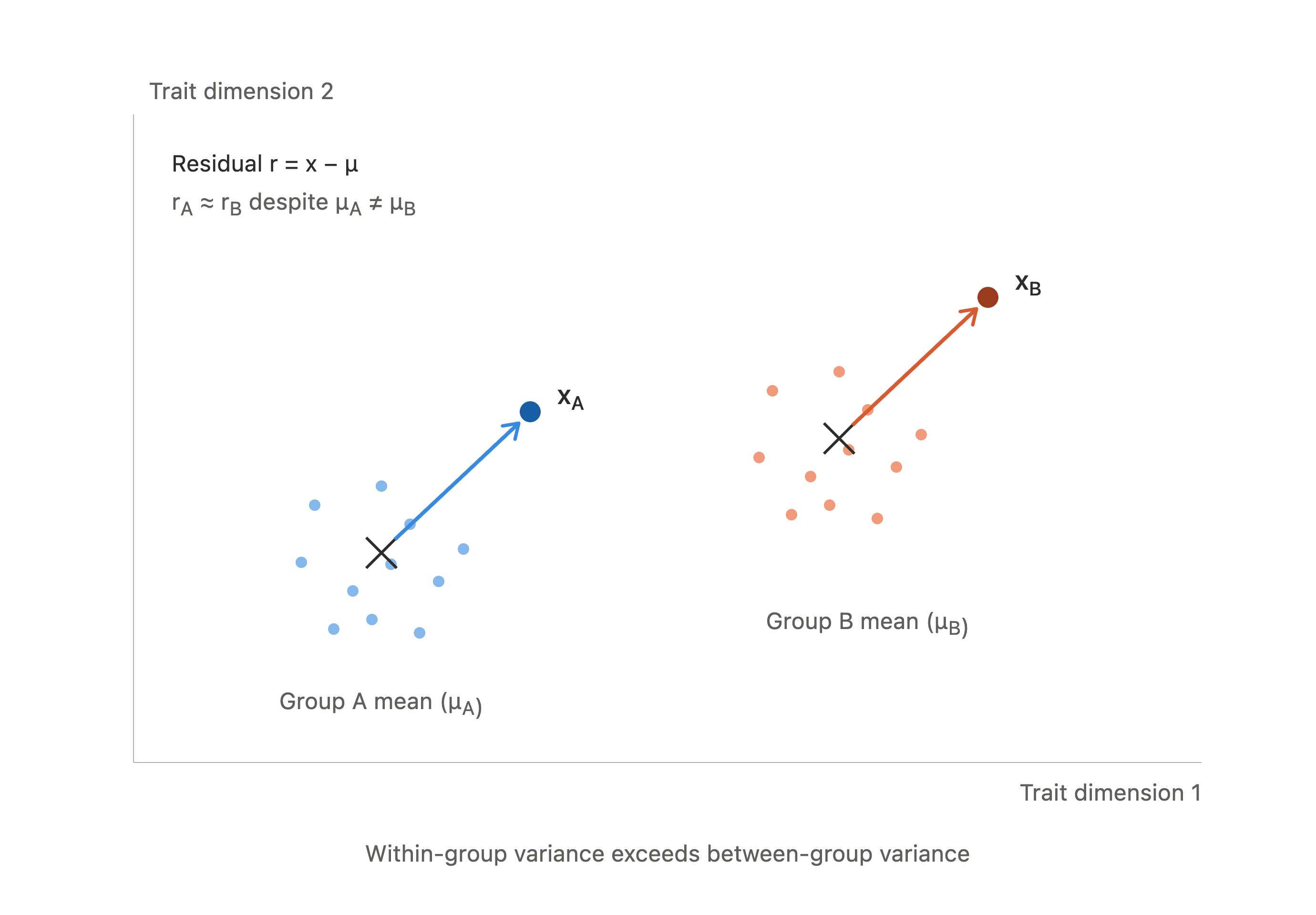
違いだらけに見える二人でも、それぞれの文化から同じ方向にずれていれば、残差ベクトルはよく似る。「まったく違う世界で育ったのに、なぜか気が合う」は、「異なる平均から、似た方向へ外れた二人が出会った」ということかもしれない。実際、価値観や性格のばらつきは、文化間より文化内のほうがずっと大きいらしい。平均が説明できる部分は、思ったより小さい。その人らしさの大半は、残差のほうに宿るのだ。
Two people who differ on the surface in nearly every way can still have near-identical residual vectors, so long as each has drifted from their own culture in the same direction. "We grew up in completely different worlds, yet somehow we click" might simply mean: two people who wandered off different averages, the same way. In fact, variance in values and personality is said to be far larger within cultures than between them. The average explains less than you'd think. Most of what makes a person themselves lives in the residual.
時間をかけて見る Seeing Someone, Over Time
もちろん「文化の平均」なんて正確には定義できないし、私は相手の全部を見ているわけでもなく、自分が気にしている数本の軸しか見ていない。だからこれは発見というより、ひとつの解釈だ。それでも、友達との感覚的な近さや遠さを、うまく説明してくれる。
Of course, "the cultural average" can't really be defined, and I'm only ever looking at the handful of axes I happen to care about, never the whole person. So this is an interpretation, not a discovery. Even so, it explains the felt sense of closeness and distance with friends surprisingly well.
属性が退くのは、勝手に起きることではない。時間をかけて、言葉を重ねて、見つめ合って、ようやく起きる。近道はない。でも、だからいいのだとも思う。言葉や文化の違いをいくつも差し引いて、それでも残り続ける何か。そこにその人の愛らしさや、ときどき、自分とよく似たものが見える。
And attributes don't step backstage on their own. It takes time — words exchanged, both people actually looking at each other. There's no shortcut. And I think that's rather the point. Subtract every difference you can name, and something still remains. That's where you find a person's particular charm — and sometimes, something oddly like yourself.
新しい友人に出会って、新しい自分に出会う機会を、私たちがもっと持てるといいと思う。
I hope we all get more chances like that — to meet a new friend, and through them, a new version of ourselves.